A Win for Mother Nature
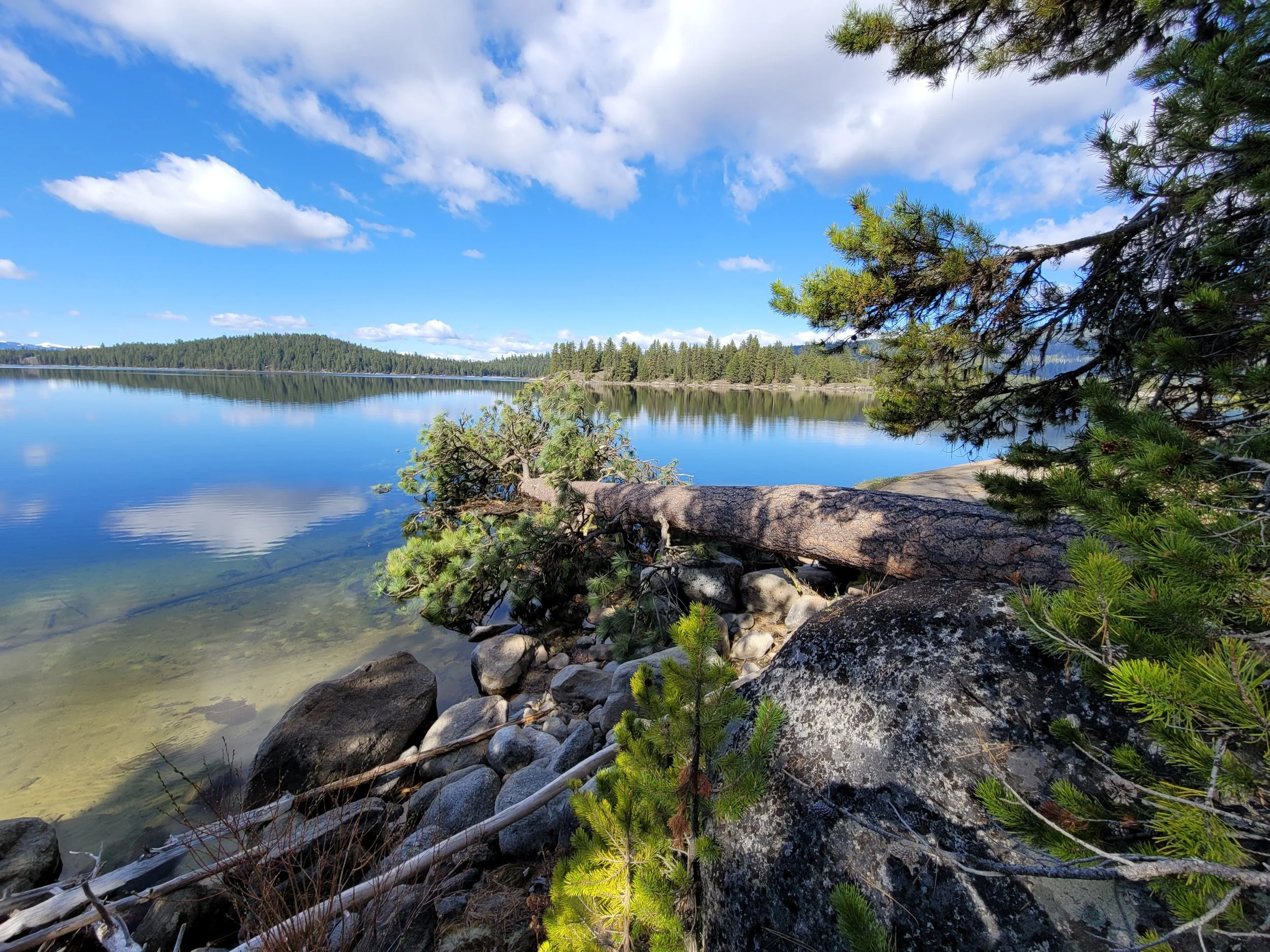
But not without scars
A few years back, my husband Bill was walking our dog along a road we often travel, a hilly, washboarded affair that wraps around the undeveloped side of Payette Lake. Imagine a rocky shoreline protected by ponderosa pine, Douglas fir, grand fir, spruce, and tamarack. Goat-steep banks covered in huckleberry bushes, bearberry, and trillium. A small, crystal-blue bay framed by an archipelago of tiny islands, and backdropped by the imposing granite elevation of the Idaho Batholith. Finally, the gravel road on which Bill and Gus were taking their walk.
This designated scenic route can get busy during the summer months, but goes largely unused the rest of the year. It was late fall with snow just around the corner, and the last thing Bill expected to hear were chainsaws. Past the first bend, there was a logging crew cutting down trees on a popular viewpoint overlooking the lake. The flats and hillside between road and shoreline were being cleared as if someone intended to build a home. However, this was state land, managed by the Idaho Department of Lands (IDL for short), so a homesite was improbable. Bill, not a shy guy, asked one of the crew what was up.
“It’s gonna be a place for holding weddings,” the man said. He went on to explain that the ‘owners’ were taking out select trees to open up the view and to clear space for driveways, parking, and an observation platform.
Holy shit, was what I thought when Bill got home and told me the news. I put on my boots, and together we tramped back up to the viewpoint that we cherished as if it were our own. And it was ours in the sense that we are all stewards of the land. That pristine stretch of shoreline is Idaho ‘endowment’ land, held in trust and open to the public for recreation purposes—as long as those activities didn’t degrade the land.
So how could somebody set up a business? Cut down trees? Excavate roads? Put up gates? Lock out all those who love this place as much as we? To say the least, we were shocked and upset. Changes such as these must be posted in advance, allowing the community time for comment and public debate. As far as we knew, none of that had taken place.
Our first course of action was to visit our local newspaper, a weekly publication that operates out of a converted 1950s house. The Star-News staff knew nothing of the wedding venue, but promised they’d get to the bottom of it. The managing editor also gave us suggestions on inquiries we could make on our own. After a week of phone calls, records requests, and visits to City and State offices, we found that the state had granted a 10-year lease on twenty-two acres along the shore as well as another six acres on the largest of the islands.
We swapped info with Star-News, and the following Thursday they published what would be the first of numerous articles on ‘The Lookout on the Lake’—an events venue that would accommodate 275 people, music until 11:00 PM, parking for their vehicles, facilities for their food and waste, stairs down to the hidden beach, and potentially boat docks and overnight ‘glamping’ yurts on the island. It was a horror show in the making.
I didn’t even care that the state was charging the business owners a paltry $4000 a year to lease the land (shoreline property that would run $25,000 to $35,000 a linear foot if bought outright). The money didn’t matter. It was the fact that this natural treasure had already been permanently altered, and was being hijacked from those who sunbathed on the rocks, built fires on the sandy beach, paddled to the island, fished off the banks, and howled at the moon. The thought of losing anything more prompted me to write my first-ever letter to the editor—a slippery slope to becoming an activist..
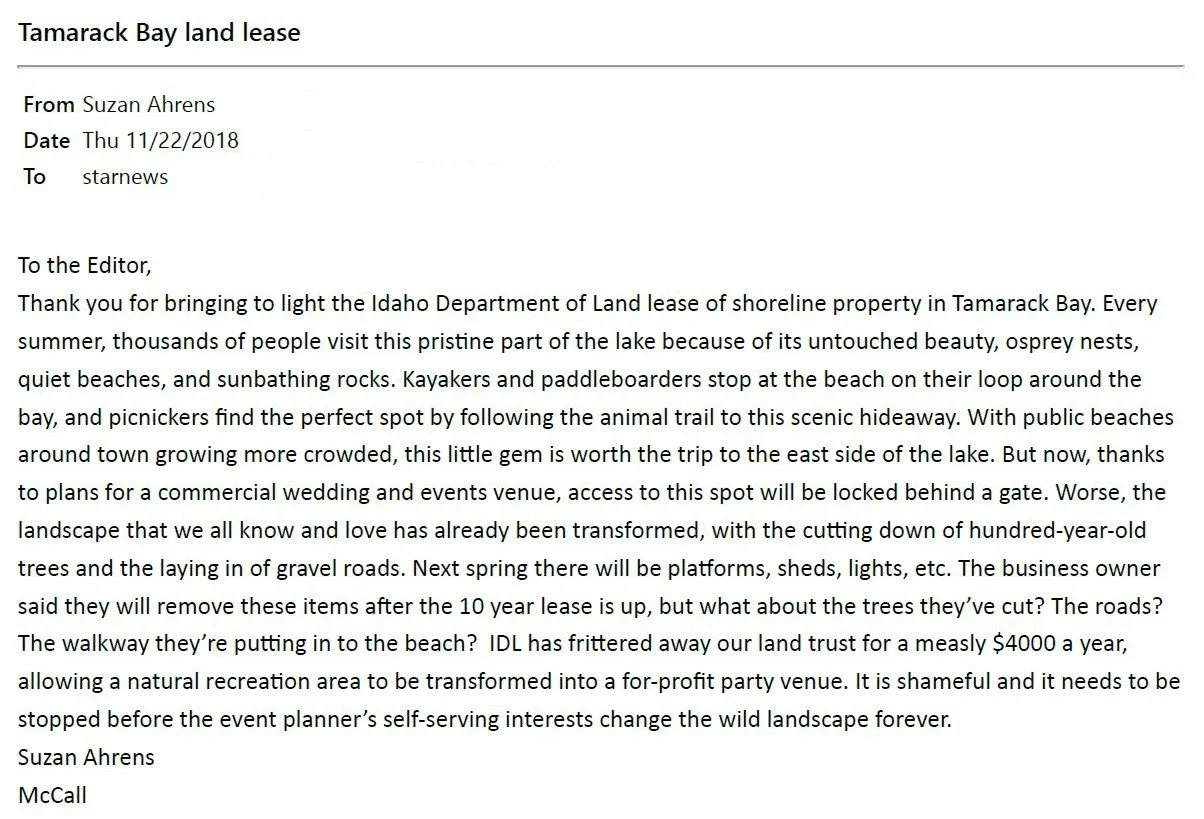
Dear Editor
Thank you Star-News for your publication.
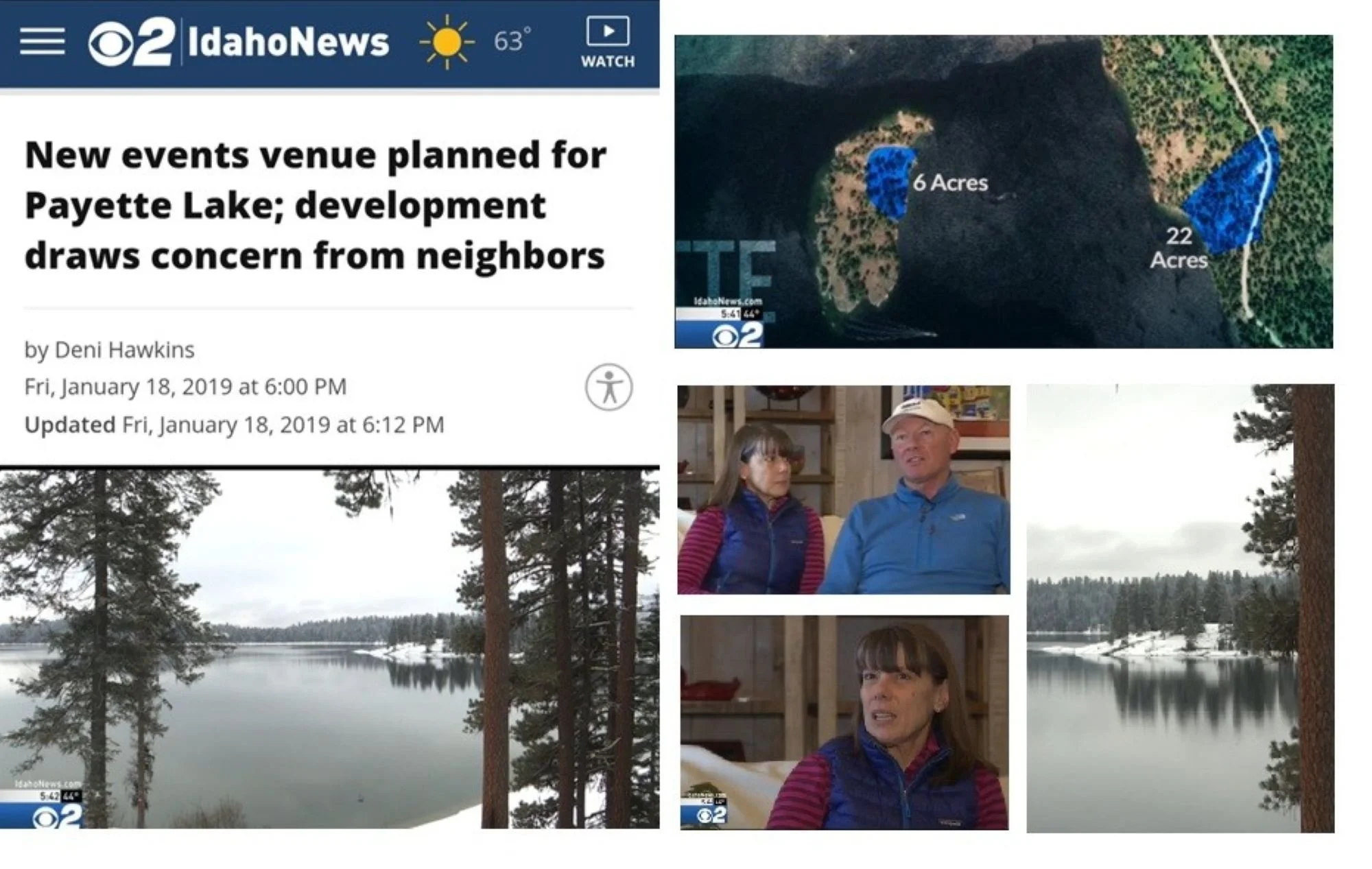
KBOI Channel 2 News Interview
All images in this clip courtesy of KBOI Boise. Thank you for your coverage.
The letter was just the beginning. Along with our neighbors, we waged a writing campaign targeting the governor’s office, did TV and newspaper interviews, attended meetings and hearings, and built a coalition that would ultimately shut down the events venue before it got started. After a two-year fight, the state conceded it did not follow protocol when issuing the lease, and it ended up reimbursing the lessee for costs incurred.
I can only take credit for a small portion of this victory, as there were people smarter and more connected than I who were able to grab the reins and run with this crusade. It took raising community awareness, raising money, enlisting land conservation experts, forming a steering committee, and hiring attorneys to get the job done. But it didn’t end there.
A good friend who had really shown up for this cause said we needed to be careful of what we wished for—and she was right. The publicity from the wedding venue had turned all eyes on this sleepy part of the lake. This time it wasn’t an individual who was willing to sacrifice nature for their personal gain, it was a big, bad land development corporation that was set on putting in a private resort and high-end homes on an even larger portion of untouched shoreline. It was a shell game: a land swap of state and federal timberland where the winner would be Trident Holdings.
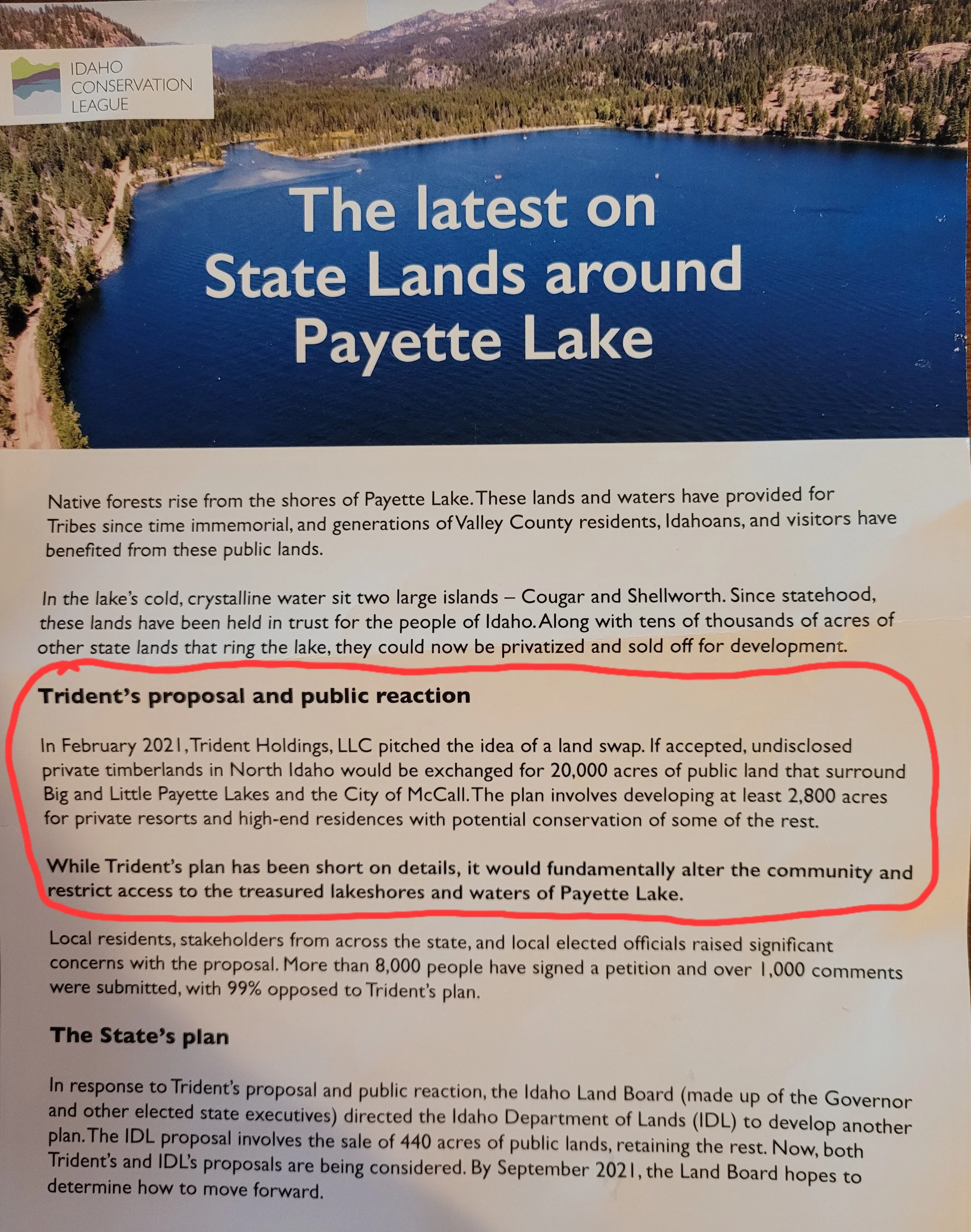
Idaho Conservation League Newsletter
Thank you ICL
What Trident hadn’t planned on was a well-organized machine that could fight them. The wedding venue had brought together the Payette Land Trust, the Idaho Conservation League, and the newly established United Payette. This coalition provided sound arguments for rejecting Trident’s proposal, and the Idaho Land Board unanimously agreed. Trident sued the state over the decision, but the court dismissed the case in 2023.
The land continues to be managed by the IDL using a long-range "Payette Endowment Land Strategy" that resulted, in large part, from these two experiences. The coalition formed by the Payette Land Trust, the Idaho Conservation League, and United Payette continues to work towards permanently protecting this beautiful shoreline. For now, at least, it is safe.
Bill and I still hike to the viewpoint and take the trail down to the hidden beach. The stumps, graveled drive, and parking lot are the scars left behind by the ill-fated wedding venue, and we often pack out trash from campers who either don’t know or don’t care about the principle of leaving no trace. Still, this jewel of nature is open for all to enjoy, and I’d say it was worth the fight.
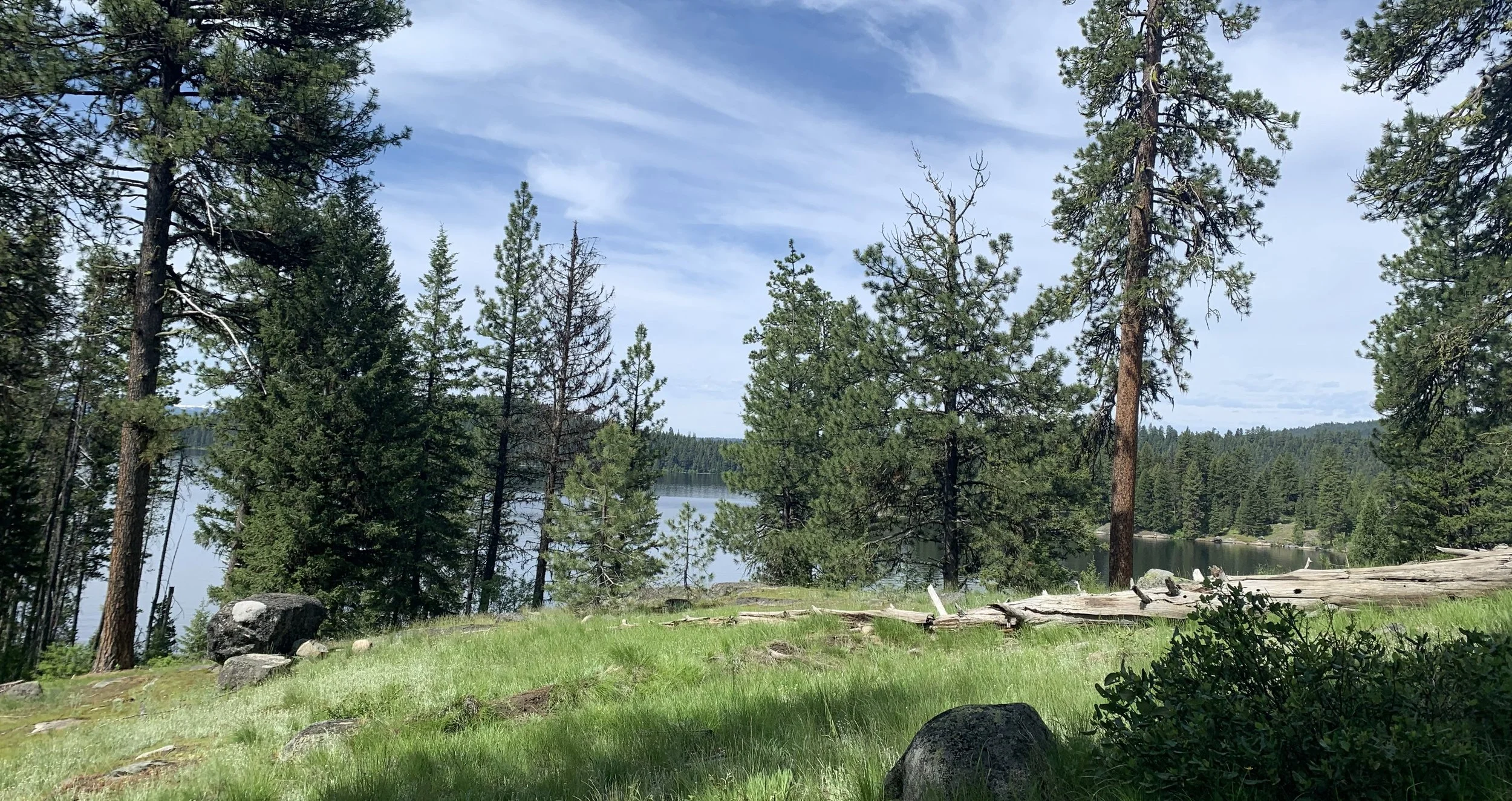
All nature photos taken by Suzan Ahrens
To comment on this post, click here for my Contact page.
