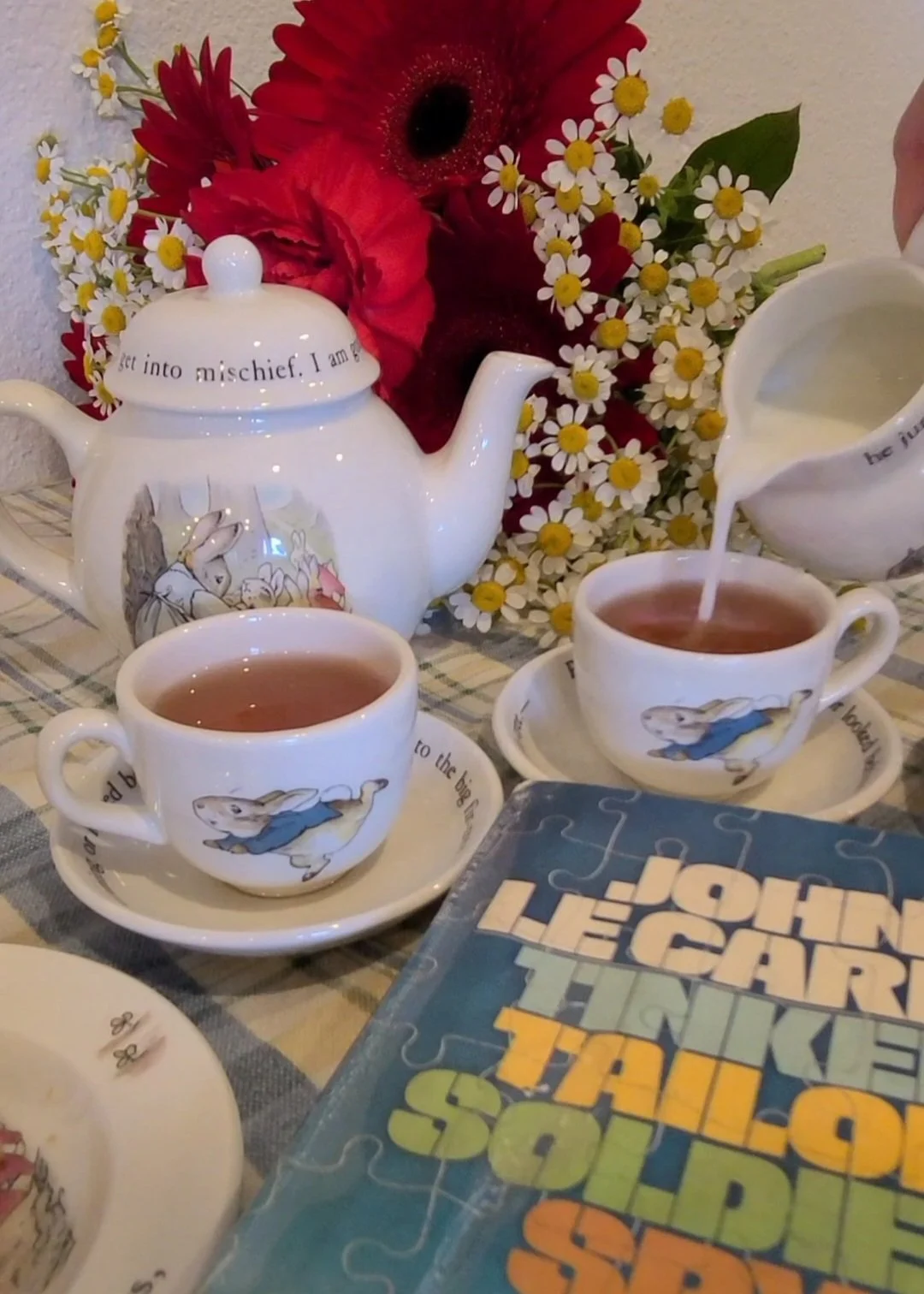
What do a child’s tea set and a book by a famous spy novelist have to do with writing murder mysteries? It takes a bit of explaining.
I was in my early twenties and had never been on a commercial flight. A trendy new clothing manufacturer in San Francisco was considering me for a position in their design department, and they wanted to meet me asap. It didn’t take psychic abilities to recognize I was in the middle of a change the course of your life moment. The kind that causes butterflies in your stomach. Makes it impossible to sleep the night before.
My boyfriend at the time thought I’d want something to read on the plane, and I accepted the tattered paperback he handed me with more than a little skepticism. Dystopian science fiction was my thing back then. Isaac Asimov’s I, Robot. Ray Bradbury’s Fahrenheit 451. Anything and everything written by Kurt Vonnegut. I was even working on my own (very bad) sci-fi novel, so a ratty copy of an outdated spy novel wasn’t exactly what I’d have chosen for myself. Still, it was a kind gesture on my boyfriend’s part, and I slipped it into my bag.
You know what comes next. An hour into the flight, I needed a distraction from my unruly jitters, and I cracked open the copy of Tinker, Tailor, Soldier, Spy. Of course, how could it not happen? British author John le Carré reeled me in with Jim Prideaux’s arrival at Thursgood’s school for boys, the reclusive hero driving a ramshackle car through a rainstorm with a second-hand camp trailer hitched behind. I mean, who wouldn’t be reeled in by this passage:
Of the whole school, therefore, only little Bill Roach actually saw Jim arrive, saw the steam belching from the Alvis’s bonnet as it wheezed its way down the pitted drive, windscreen wipers going full pelt and the trailer shuddering through the puddles in pursuit.
I fell in love with spy craft that day, and science fiction became an ex-lover to be looked back upon with fond memories. But I’m getting ahead of myself…
There were several hours to kill once I landed in San Francisco, and I spent that time knocking around Union Square (no doubt looking the part of a wide-eyed country mouse). What saved me from the full-on bumpkin cliché was the audacity that only comes with youth, and the good sense to stay out of the high-end department stores and pricy boutiques of the likes I’d never seen. My pocketbook probably had twenty bucks in the fold, and my credit card’s spending limit was surely maxed out. Window shopping was all I could afford.
I don’t recall the name of the shop where I spotted the Peter Rabbit tea set, although I remember explicitly the lacy window display that drew me through the doors to inquire about the price. After all, how expensive could a child’s plaything be? A lot, it turned out. The tiny 10-piece set was Wedgewood china, and it cost more than I paid in rent.
But oh, how I adored that little set, for reasons I still can’t quite explain. Was it my inner child needing comfort from the big, scary decisions awaiting me? After all, taking this job would mean moving to an unfamiliar city, finding new friends, and making a commitment to my boyfriend, who was willing to quit his job to move with me.
Nah. None of that scared me. Really, I was too young and naïve to be daunted by any of it. Whatever the beckoning force behind wanting that tea set, it wasn’t fear. I left the store with a promise that if I landed the job, I’d be back for Peter Rabbit. Two weeks later, after dropping off the U-Haul, I made good on that promise.
It pleases me to no end that both the tea set and the book have survived these many years, the multiple moves, and more jobs and relationships than I want to admit. Yet still, I ask: What do the two of them have to do with writing murder mysteries? For me, they are a commentary on the multi-faceted nature of human beings. An illustration of how a person can hold dear both a frivolous collection of fine bone china and a master spy’s tale of espionage and treason. They are examples of how opposing forces can bring depth and texture to any writer’s work—and where murder mystery comes into play—are an absolute necessity for creating the layers needed to build a convincing bad guy.
Now, anyone for a splash of milk in your tea?
Author’s note: I still haven’t convinced my husband to sit down with me and have a tea party, but after this post, perhaps he will.
Words and images by Suzan Ahrens. All rights reserved.
To comment on this post, please click here for my Contact page.
